
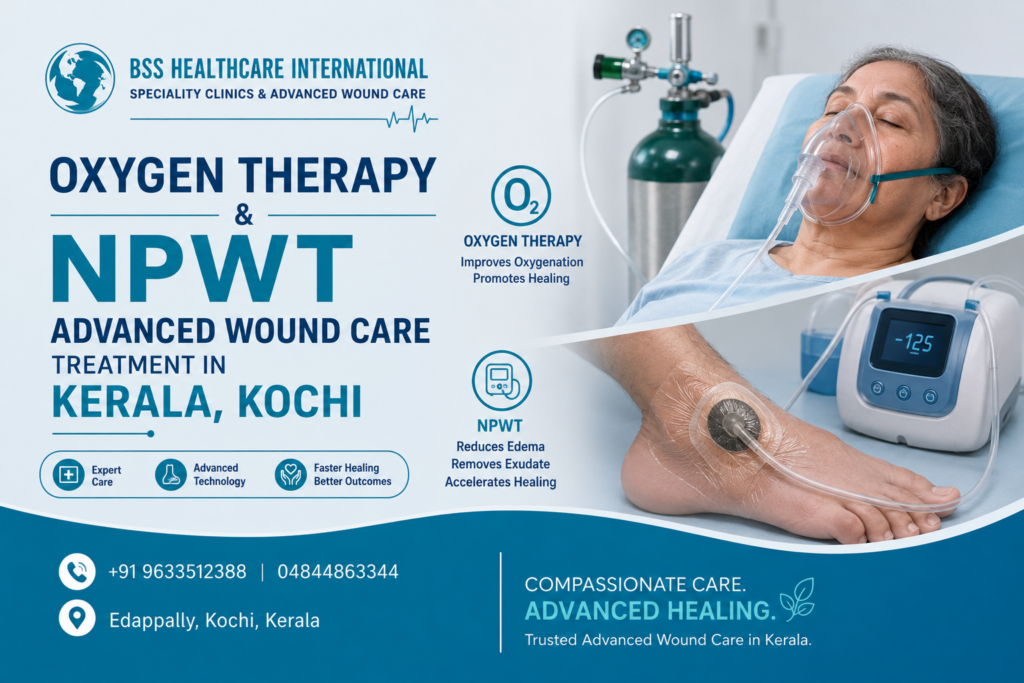
Oxygen Therapy & NPWT Advanced Wound Care Treatment in Kerala, Kochi can provide specialized support for selected complex and slow-healing wounds. These advanced treatments may be considered when a wound does not respond adequately to conventional wound care and when a medical assessment shows that additional therapy may be beneficial.
For patients in Kochi and across Kerala, understanding how oxygen therapy and Negative Pressure Wound Therapy (NPWT) work can help them make informed decisions about advanced wound management.
What Is Advanced Wound Care Treatment?
Advanced wound care involves specialized medical approaches designed to support the healing of difficult or chronic wounds.
A wound may take longer to heal because of factors such as:
- Diabetes
- Poor circulation
- Infection
- Pressure or prolonged immobility
- Surgical complications
- Large or deep wounds
- Excessive wound fluid
- Tissue damage
- Other underlying medical conditions
Treatment should begin with a proper wound assessment. Depending on the condition, a healthcare professional may recommend wound cleaning, debridement, infection management, appropriate dressings, pressure relief, nutritional support, vascular assessment, or advanced therapies.
What Is Oxygen Therapy for Wound Healing?
Oxygen therapy can refer to different medical approaches. In advanced wound care, hyperbaric oxygen therapy (HBOT) involves breathing oxygen in a pressurized chamber.
Oxygen is important for several stages of wound healing. In selected patients with problem wounds, HBOT may be used as an adjunctive treatment, meaning it is used alongside appropriate standard wound care rather than replacing it.
The Undersea & Hyperbaric Medical Society identifies the strongest evidence for HBOT in selected ischemic, infected diabetic foot ulcers of Wagner Grade III or higher.
How Can Oxygen Therapy Support Wound Care?
Depending on the patient’s condition, oxygen therapy may help by:
- Increasing oxygen availability to tissues
- Supporting tissue repair
- Supporting the body’s healing processes
- Helping selected wounds where inadequate tissue oxygenation is a concern
However, oxygen therapy is not suitable for every wound. A qualified medical team should determine whether it is appropriate after evaluating the wound, circulation, infection status, and overall health.
What Is NPWT?
Negative Pressure Wound Therapy (NPWT) is an advanced wound treatment that uses controlled suction through a specialized dressing and pump.
A sealed dressing is placed over the wound and connected to a suction device. The negative pressure helps remove excess wound fluid and can support the development of healthy tissue.
NPWT may be considered for certain difficult wounds, including wounds that are large, deep, or producing significant amounts of wound fluid.
How Does NPWT Work?
The basic process involves:
- The wound is assessed and prepared by a healthcare professional.
- A suitable foam or gauze dressing is placed over the wound.
- The dressing is sealed with a special film.
- A tube connects the dressing to a suction pump.
- Controlled negative pressure removes wound fluid into a collection container.
- The healthcare team regularly assesses the wound and changes the dressing as required.
NPWT can help remove excess fluid, encourage healthy tissue formation, bring wound edges together, and provide a protected wound environment.
Oxygen Therapy vs NPWT: What Is the Difference?
Although both may be used in advanced wound management, they work differently.
| Treatment | Main Approach | Potential Role |
|---|---|---|
| Oxygen Therapy / HBOT | Increases oxygen exposure under controlled conditions | Selected wounds where additional oxygenation may be beneficial |
| NPWT | Uses controlled negative pressure | Helps manage wound fluid and support granulation and wound closure |
| Standard Wound Care | Dressings, cleaning, debridement and other measures | Foundation of wound management |
The appropriate treatment depends on the individual wound. In some cases, advanced therapies may be combined with standard wound care and other medical treatments.
Who May Need Advanced Wound Care?
Advanced wound care may be considered for people with wounds that are difficult to heal or require specialized management.
Examples can include:
- Selected diabetic foot ulcers
- Chronic non-healing wounds
- Complex surgical wounds
- Certain wounds with significant drainage
- Selected ischemic or poorly healing wounds
- Wounds requiring specialized wound-bed management
Not every chronic wound requires oxygen therapy or NPWT. A proper clinical assessment is essential before choosing an advanced treatment.
Why Early Wound Assessment Matters
A wound that does not appear to be healing should not simply be treated with increasingly complex dressings without finding the underlying cause.
A wound-care assessment may consider:
- Wound size and depth
- Signs of infection
- Blood circulation
- Blood glucose control where relevant
- Amount and type of wound drainage
- Presence of dead or unhealthy tissue
- Pressure on the affected area
- Nutrition and general health
- Previous wound treatments
Early evaluation can help healthcare professionals identify factors that may be preventing healing.
What Can Patients Expect During NPWT?
NPWT is generally applied and monitored by trained healthcare professionals. Patients may feel a mild pulling or suction sensation when therapy begins. Some people may experience discomfort during dressing changes, depending on the wound and its location.
The duration of NPWT varies. It depends on factors such as wound size, wound type, general health, and how the wound responds to treatment.
Oxygen Therapy and NPWT in Kochi, Kerala
For people looking for Oxygen Therapy & NPWT Advanced Wound Care Treatment in Kerala, Kochi, choosing an experienced wound-care team is important.
Advanced wound management should be individualized rather than based only on the type of equipment or therapy available. The healthcare team should first evaluate the wound and determine whether oxygen therapy, NPWT, conventional wound care, or a combination of approaches is appropriate.
At BSS Healthcare, advanced wound-care services can be presented as part of a patient-focused approach to managing difficult and slow-healing wounds.
The goal of wound care is not simply to cover a wound. It is to understand why the wound is not healing, manage contributing factors, protect the wound, and support the body’s natural healing process.
A Simple Advanced Wound Care Journey
A typical wound-care pathway may include:
Assessment → Diagnosis → Wound Cleaning/Debridement → Infection & Underlying-Cause Management → Appropriate Dressing → Advanced Therapy When Indicated → Regular Monitoring
This structured approach helps ensure that advanced treatments are used when clinically appropriate.
Frequently Asked Questions
Is oxygen therapy suitable for every wound?
No. Oxygen therapy, particularly HBOT, is not appropriate for every wound. Its use depends on the type and severity of the wound and the patient’s overall clinical condition. Evidence is strongest for selected severe diabetic foot ulcers.
What is NPWT used for?
NPWT uses controlled suction to remove excess wound fluid and support the wound-healing environment. It may be useful for selected large, deep, or heavily draining wounds.
Can NPWT be used at home?
In some cases, patients can continue NPWT outside the hospital with appropriate professional supervision and instructions.
How long does NPWT treatment take?
There is no single treatment duration for everyone. The healthcare team determines the duration based on the wound’s size, type, progress, and the patient’s overall health.
Can oxygen therapy and NPWT be used together?
They may be used as part of a broader wound-care plan in selected patients, but this decision should be made by the treating medical team after assessing the wound and underlying conditions.
When should I seek advanced wound care?
If a wound is not healing as expected, repeatedly breaks down, produces significant drainage, develops signs of infection, or occurs in a person with conditions that can impair healing, professional wound assessment is important.
Where can I find advanced wound care treatment in Kochi?
Patients searching for advanced wound care treatment in Kochi, Kerala should consult a qualified wound-care professional who can assess the wound and recommend an appropriate treatment plan.
Conclusion
Oxygen Therapy & NPWT Advanced Wound Care Treatment in Kerala, Kochi represents a specialized approach for selected difficult-to-heal wounds. Oxygen-based therapies and Negative Pressure Wound Therapy work through different mechanisms and may form part of a broader treatment plan.
The most important step is a professional wound assessment. Advanced treatment should be selected according to the wound type, underlying cause, circulation, infection status, and overall health of the patient.
For patients in Kochi seeking specialized wound-care support, timely assessment and appropriate treatment can be an important part of managing complex wounds.